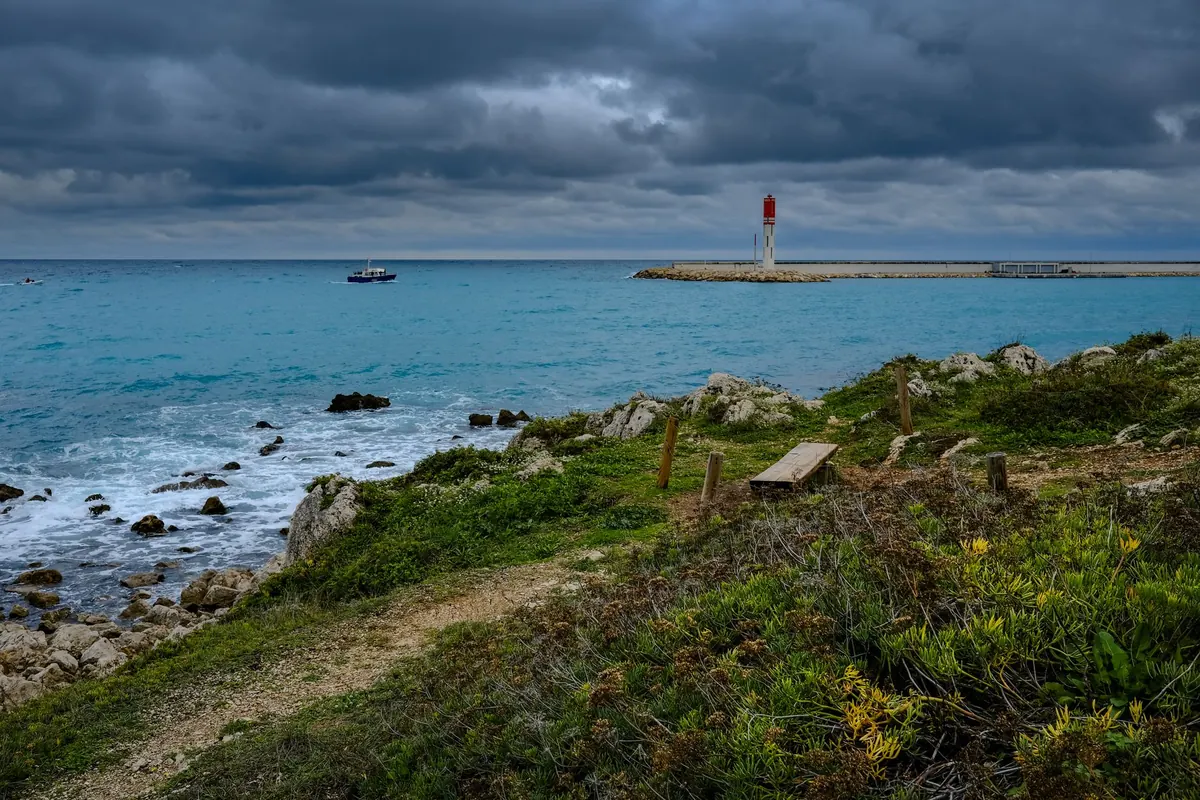
Stand on a dark quay and wait for the sweep. A beam comes round every ten seconds, bright enough to throw a shadow of the railings behind you, then the night closes again. Somewhere inside that lantern a piece of optics is doing the work: either a stepped glass lens cut by hand in the 1800s, or a cluster of light-emitting diodes on a machined heat sink. Both do the same job. They just solve it in opposite ways, and the difference explains almost everything you notice about a modern light.
What Fresnel Actually Solved
Before the 1820s, most lighthouses used a lamp with a parabolic reflector behind it: a silvered copper dish that caught some of the flame's light and pushed it out to sea. It worked, but crudely. The flame radiated in every direction, the reflector only collected a slice of that, and a good deal of what it did collect was lost before it left the lantern glass.
Augustin-Jean Fresnel's idea was to stop thinking of the optic as a mirror and start treating it as a series of prisms. Build a lens in concentric rings, each ring a prism angled slightly differently, and every ring bends the light from the lamp into the horizontal plane. Because each prism only has to bend light through a small angle, it can be thin and light. A conventional lens with the same focal length would have been a lump of glass so thick and heavy it was impractical to mount, let alone rotate. The first full Fresnel lens went into the Cordouan lighthouse in France in 1823, and lighthouse design changed within a generation.
The Optic as an Engine
A Fresnel lens is not just glass. It is a machine with the lens as its working part.
Orders and focal length
Optics were built in standard sizes called orders, from the first order — roughly a metre of focal length, standing taller than most visitors expect — down to sixth-order lights small enough for a harbour pier. The order told an engineer how much light the optic could gather and how tightly it could focus it. A first-order lens on a high headland and a sixth-order lens on a breakwater were doing the same optical job at different scales.
Flash character
The familiar flashing came from movement. The whole optic sat on a bath of mercury, which reduced friction to almost nothing, and a clockwork drive turned it: a weight on a cable descending through the tower, rewound by the keeper every few hours. Later versions used electric motors. Group flashes were created by blanking panels or by arranging the lens panels in groups, so that a mariner counting two flashes, then six seconds of dark, then two more, could identify the station without a chart in hand.
What an LED Beacon Does Differently
An LED beacon removes the machinery. Light output is switched electronically, so nothing has to rotate to produce a flash. That single change cascades through the whole design:
- No clockwork, no mercury. Fewer moving parts on a rock that is expensive to visit, and no toxic metal to handle when the optic is serviced.
- Far less power. A solar panel and a battery bank can carry a moderate station through long winter nights, which matters on offshore reefs where running a cable is impossible.
- Smaller lanterns. A modern head can be compact, though heritage towers often keep the original lantern room regardless.
- Arrays instead of a single source. One emitter rarely produces enough intensity on its own, so designers use several LEDs behind collimating optics and aim them as a single beam.
- New failure modes. Heat sinks, driver electronics and surge protection become the parts that need attention, rather than brass bearings and lamp wicks.
The Trade-offs Nobody Puts in the Brochure
Focus is the interesting problem. A beam that is too tight vertically can be worse than a broader, weaker one, because the sea is not flat and a small boat pitches. If all the light is concentrated in a sliver just above the horizon, a mariner in a swell will lose the light for seconds at a time. Good beacon design keeps some vertical spread; it is one reason a modern optic's beam profile is specified as carefully as its peak intensity.
Colour and wildlife are the other two. White LEDs tend to run cool, with a blue component that looks different from the warm glow of an oil lamp, and cold white light on an isolated structure is known to draw seabirds, which circle until they drop. Where that is a concern, warmer emitters or shielded fittings help. And plastic optics, common in cheaper LED heads, degrade under ultraviolet light in a way that glass never does; a well-specified station uses materials chosen for a decade of sun and salt, not a season of it.
The Hybrid Most Stations Actually Chose
Walk into a working lighthouse today and you will often find both technologies in the same room. The original Fresnel lens stays in place, restored and polished, and an LED lamp sits at its focal point where the oil burner used to be. The glass still shapes the beam and still produces the station's characteristic flash pattern as it turns; the light source behind it simply draws a fraction of the power and needs no wick trimmed at midnight.
That arrangement is not nostalgia. The lens is the part that gives the light its identity, and in many places it is a protected historic object. Replacing the lamp is maintenance; replacing the optic is an architectural decision.
What Changes for the Mariner
Less than you might think. A light's character — its pattern and period — still matters more than its brightness, because that is how you identify it. What has changed is the paperwork and the redundancy. Charts and light lists quote a nominal range at a stated meteorological visibility, and the range you actually see depends on the height of your eye, the clarity of the air and the height of the light. A bright LED does not defeat fog; it may simply be visible for a shorter distance than the number suggests.
Behind the visible beam there is now usually more: a standby lamp that switches automatically, remote monitoring that tells a control centre when a station fails, and often AIS or radar transponder augmentation for vessels that never look up from a screen. The light is one layer in a stack of aids, not the whole system.
How to Read a Lighthouse Optic on Your Next Visit
Whether you are standing in a museum gallery or on a tower tour, a few minutes of looking gets you most of the way to understanding what you are seeing.
- Find the bullseye — the large centre prism. That is the part aimed straight at the horizon.
- Count the panels around the frame. If it rotates, each panel passing your eye is one flash of the character.
- Look for the clockwork. Weight tubes, cables and a mercury trough tell you the optic was designed to turn.
- Ask what the light source is. An LED lamp inside an old lens means you are looking at a hybrid, which is now the common case.
- Time the flashes for a full cycle against a watch or the charted character. You will remember the pattern far longer than the view.
Old glass and new diodes are not rivals so much as two answers to the same question: how do you put a reliable mark on the water with the least fuss and the most light. Knowing which one you are looking at makes the beam feel less like scenery and more like a piece of working engineering.
Photo: KlausHausmann / Pixabay